The terrified victim rears up on his hind legs and veers away in a desperate bid to escape, but it is no use.
Blood is pouring into his eyes and he can no longer see. His right ear is torn and bloody.
Scroll down for more...
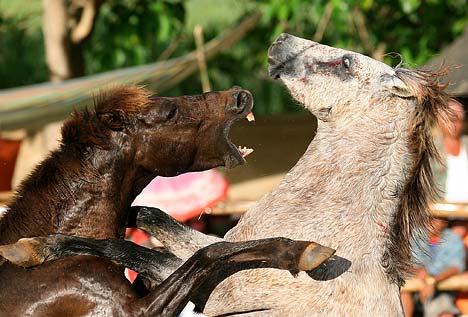
Fight club: Goaded into a frenzy by a mare who is 'in season' and chained nearby for up to six hours, stallions battle for 'sport' in the Philippines
The bigger horse moves in for the coup de grace, repeatedly kicking the weaker animal in the head with his front hooves.
His opponent soon collapses and lies panting on the ground, an all too typical end to one of the most horrific spectator 'sports' ever devised - horse-fighting tournaments.
But that hasn't stopped them becoming hugely popular in the Philippines, where these appalling pictures were taken.
The images are deeply disturbing, but the Mail believes they must be seen.
"These tournaments are truly barbaric," says Andrew Plumbly of the welfare group Network for Animals, which has been campaigning to bring an end to the savage contests.
Scroll down for more...

These scenes in the town of Don Carlos involved 54 horses, many of which had gruesome injuries
Horse-fighting occurs almost exclusively in Mindanao in the southern Philippines, and in parts of China.
The horrific tournament captured in our photographs happened in the town of Don Carlos and involved 54 horses, many of which had gruesome injuries.
Thousands of people turned out to watch the bloodbath, including hundreds of children. Many of the adults were drunk and spent their time gambling and jeering at the battling animals.
Though horses do not normally fight one another, these stallions had been whipped into a fighting frenzy by the presence of a young mare who was "in season" and had been staked to the ground in the middle of the muddy arena.
Overwhelmed by desire, the stallions attacked each other in a bid to defeat their sexual rivals.
Scroll down for more...

Wounded horses are often killed for their meat and the choicest cuts barbecued and sold to the crowd
The tournament was equally traumatic for the mare used as "bait" for the stallions.
Not only was she repeatedly hit by stray blows from the duelling horses, but the poor creature was also obliged to mate with the victorious stallions from each "bout", meaning that she was mounted as many as 30 times during one tournament which can last up to six hours.
"Horses often die in the ring from exhaustion or their injuries," says Mr Plumbly, who has witnessed one such tournament.
Veterinary care is too expensive for most owners to bother with, so wounded horses are often killed for their meat and the choicest cuts barbecued and sold to the crowd.
A similar fate awaits those horses deemed too old or too weak to fight. These are "sacrificed" by pitting them against much stronger stallions.
Some break their legs as they desperately try to escape. But the bloodier the injuries, the louder the crowd cheers.
Although horse-fighting is illegal in the Philippines, corruption and lack of enforcement ensure that the tournaments continue - and with apparent official sanction.
Matches are featured on TV, and local businesses sponsor horses and tournaments. Local authorities offer prize money.
The tournaments are promoted as a "cultural tradition", but in fact they are largely organised and controlled by crime syndicates, who rake in huge profits from gambling.
Thousands of pounds are bet on each fight - a small fortune in a desperately poor country such as the Philippines.
Scroll down for more...

The tournaments are promoted as a 'cultural tradition', but in fact they are largely organised and controlled by crime syndicates
"If people want to help stop these tournaments they should write to the embassy in London and tell them that they will not visit these islands," says Mr Plumbly.
"The threat of a loss of tourism money will help bring this despicable blood sport to an end."
• For more information on NFA campaigns and how you can help, visit www.networkforanimals.org.


